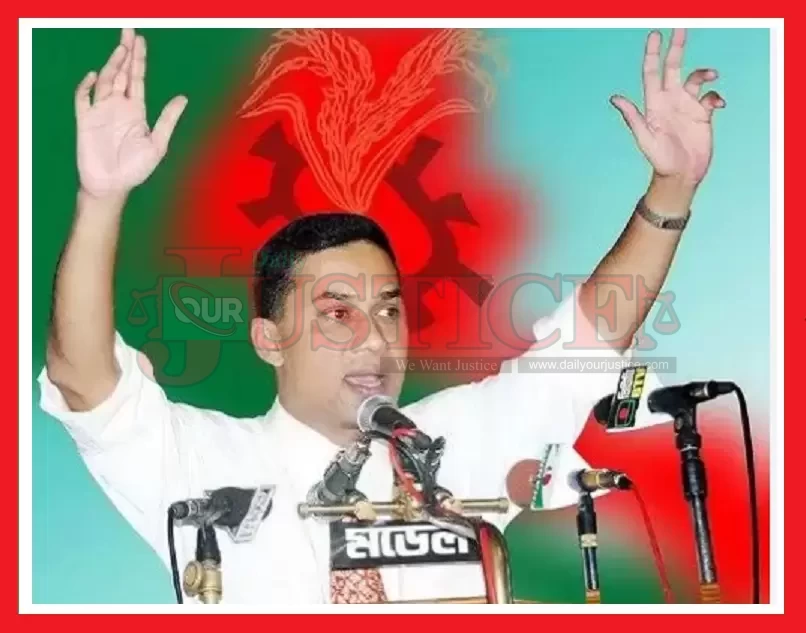
Special Correspondent : If the four-party alliance government was corrupt, then why did Jamaat-e-Islami’s two top leaders never resign at the time? Tarique Rahman has raised the question, challenging Jamaat’s present-day criticism of the BNP.On Tuesday, he referred to a particular political party, pointing towards Jamaat, saying it is acting in “exactly the same way the ‘autocrat’ used to speak”.
“You must have seen in the newspapers that right now a political party is using the language of the autocrat who has fled, attacking the BNP… it too is now claiming that the BNP was the champion of corruption.”“So my question is, from 2001 to 2006 didn’t they also have two members in the BNP government? They did. So if the BNP was really that bad, why didn’t those two individuals resign and walk away?”
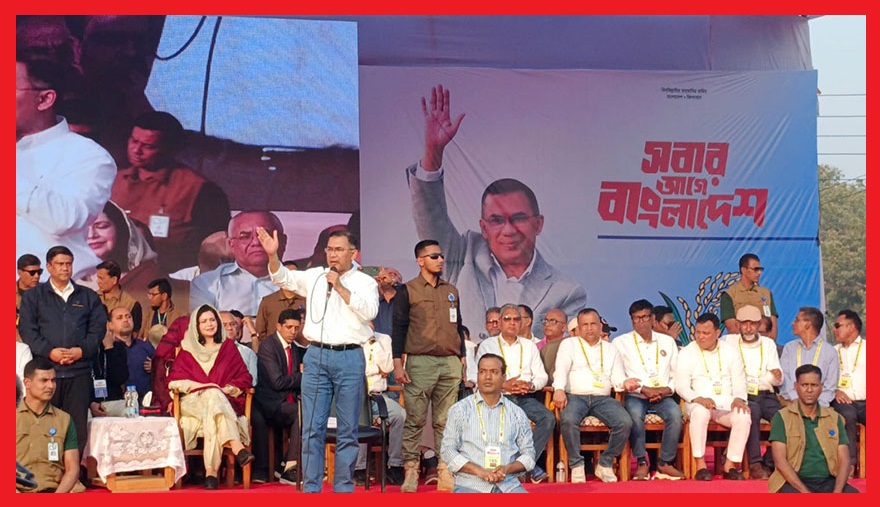
Tarique was addressing an election rally on Tuesday afternoon at the Mymensingh Circuit House ground.Referring to Jamaat leaders, he said: “Why didn’t they resign? They did not resign because they were in government and they knew very well that Khaleda Zia was cracking down on corruption with a firm hand.“And the party that is now making these allegations — its two members were part of the BNP government and they knew perfectly well that Khaleda Zia did not tolerate corruption.”
During the 2001–2006 term, the Jamaat-e-Islami’s then chief Motiur Rahman Nizami and secretary general Ali Ahsan Mohammad Mujahid served as ministers in the BNP-led four-party alliance government.Nizami was first appointed agriculture minister and later given charge of the industries ministry. Mujahid served as social welfare minister.
During the tenure of the previous Awami League government, Nizami and Mujahid were executed following verdicts of the International Crimes Tribunal over war crimes committed during the 1971 Liberation War.Tarique added, “All kinds of international statistics show that during Khaleda Zia’s time the country was at a low level of corruption.
“And when Khaleda Zia took charge in 2001, Bangladesh slowly began to come out of the vicious grip of corruption.“And the fact that the two members of the party now making these accusations stayed in the government from the very first day to the last proves just how big a lie they are telling about their own people.”As part of his nationwide election campaign, Tarique arrived in Mymensingh by road around 3:30pm.Party leaders and activists from Mymensingh, Jamalpur, Netrokona and Sherpur joined the public rally.
Addressing the gathering, Tarique urged supporters to remain united before the Feb 12 election, likening the call for unity to the spirit of 1971.He said the Liberation War had brought together people of all backgrounds, noting that neither ethnicity, religion nor region had divided those who fought for freedom.
He also referred to the mass movement of Aug 5, 2024, saying people from all walks of life had again stood together to protect the country’s independence.“In 1971 or in 2024, no one asked who belonged to the hills or the plains, or who followed which faith,” he said, adding that the same unity was needed to ensure victory in the upcoming election.
Explaining the importance of unity, Tarique said it had helped the nation achieve independence and later remove authoritarian rule.He said unity was essential to establishing people’s rule, ensuring accountability and transforming Bangladesh into a state governed in the interests of its citizens.
Urging voters to remain vigilant on polling day, Tarique asked supporters to line up early at polling centres and remain there even after casting their votes.“For years, people were denied the chance to vote, and votes were taken away,” he said. “This time, we must stay alert so no one can steal our votes.”Highlighting regional issues, he described Mymensingh as a key agricultural area and said many canals and wetlands had been filled in over the years.“We want to re-excavate these canals,” he said.
He also addressed drug abuse in districts such as Netrokona and Sherpur, saying the problem could only be tackled by creating employment opportunities for young people.“When people have jobs, businesses and livelihoods, they will not fall into drugs,” he said.Tarique said a BNP government would expand vocational institutions to provide training for young people, enabling them to find work both at home and abroad.
He added that the party had plans to offer IT training so that young professionals could earn income remotely.Before taking the stage, Tarique met families of those killed and injured during past movements, exchanging greetings and enquiring about their wellbeing.
He also outlined proposed welfare initiatives, including family cards for women, farmer cards for agricultural workers, health cards for all citizens and measures to address unemployment.Introducing 24 BNP candidates from Mymensingh, Jamalpur, Netrokona and Sherpur, he urged voters to elect them under the party’s Sheaf of Paddy symbol so they could serve the people.
After the Mymensingh rally, Tarique left for Gazipur’s Rajbari College ground for his next campaign event.He formally launched his election campaign on Jan 22 after visiting Sufi saint Hazrat Shah Paran’s shrine after praying at Hazrat Shahjalal’s resting place in Sylhet, addressing seven rallies across multiple districts that day.The second phase of the campaign began from Chattogram last Sunday, where he spoke at five rallies across Chattogram, Feni, Cumilla and Narayanganj.