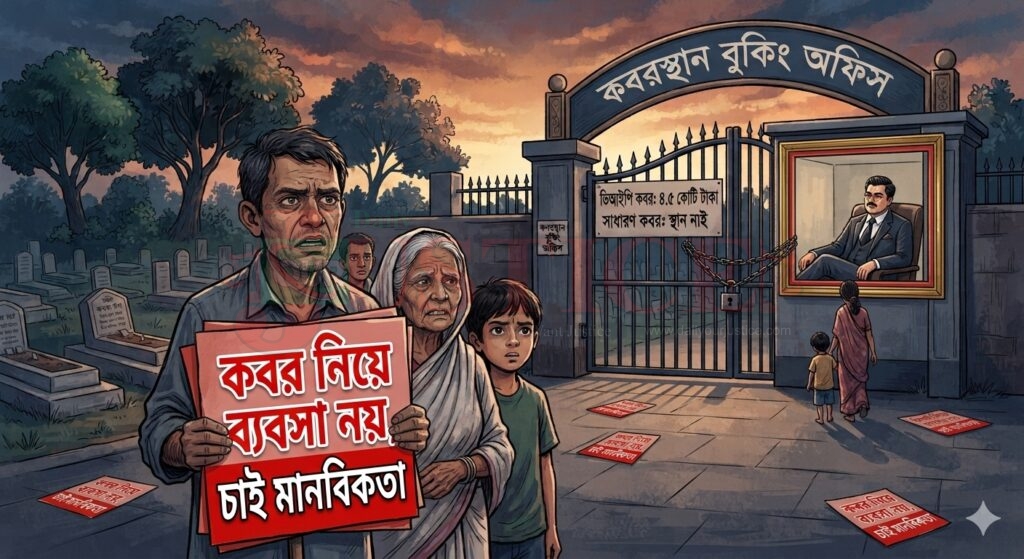
Labonno Chowdhury: In a city where multi-million-taka apartments pierce the sky, Dhaka’s hyper-inflated real estate market has finally crossed a sacred boundary: it has entered the realm of the dead. Today, securing a 25-year burial plot in Banani can cost a staggering Tk 4.5 crore, turning a solemn religious duty into a high-stakes luxury transaction. As the wealthy buy up centuries of peace, the city’s low-income families are left with an agonizing question: Has the capital become a place where the poor can no longer afford to die?
In the heart of the bustling metropolis, where skyscrapers fiercely compete for every square inch of the horizon, another, quieter crisis is unfolding beneath the surface. It is a crisis of the final resting place.
For generations, death was considered the ultimate equalizer. Rich or poor, absolute monarch or penniless laborer, everyone eventually returned to the same three and a half cubits of earth. Today, however, that comforting truth is being heavily eroded by the modern machinery of greed. The commercialization of graveyards and burial spaces has turned the solemn ritual of mourning into a high-stakes real estate market, leaving grieving, low-income families to ask a devastating question: Can the poor even afford to die anymore?
When Grief Becomes a Transaction
Consider the story of Rahima Begum, a resident of a cramped suburban settlement. When her husband passed away after a long, financially draining illness, her grief was immediately eclipsed by panic. The public graveyard nearby was overcrowded, and securing a long-term spot required bureaucratic connections or an exorbitant “maintenance fee” that her family simply could not afford.
“We spent everything we had on his hospital bills and oxygen,” Rahima says, her eyes welling with tears. “When he died, I thought the earth would accept him. Instead, I had to haggle, plead, and borrow money just to ensure his grave wouldn’t be dug up and reused in a few short months. It felt like his dignity was being auctioned off.”
Rahima’s story is not unique. Around the world, urban expansion and commercial interests are converting what should be public, sacred spaces into profitable enterprises. Private cemetery boards, corrupt intermediaries, and premium “luxury” burial packages are setting prices that alienate the impoverished. Plots are bought, sold, and leased like commercial property. If a family fails to pay ongoing rental or upkeep fees, the remains of their loved ones risk being displaced.
A Departure from Faith and Community
Historically, laying the dead to rest was a communal obligation rooted deeply in spiritual and social solidarity. In many cultural and religious traditions, volunteering to dig a grave or helping a family arrange a funeral is viewed as one of the highest acts of selfless virtue. It is a collective responsibility (Farz-e-Kifayah) meant to ensure that no human being is abandoned in death.
When the final resting place becomes an industry driven solely by profit margins, this social fabric disintegrates. Treating graves as commercial real estate turns a profound spiritual milestone into a heartless transaction. It strips away the empathy that defines us as a civilized society.
Restoring Dignity: A Call for Action
The solution does not lie in halting development, but in restoring a sense of collective conscience. To counter the predatory commercialization of death, communities must advocate for:
-
- Strict Regulatory Protections: Governments and local municipal authorities must mandate that public burial grounds remain strictly non-commercial and protected from corporate land grabs.
- Subsidized Care for Low-Income Families: Every citizen, regardless of economic standing, must be legally guaranteed a permanent, dignified, and cost-free burial.
- Community-Led Initiatives: Re-establishing volunteer committees to manage local graveyards can keep costs transparent and prioritize support for those facing sudden financial hardships.
Humanity Above All
A society is ultimately judged not by the height of its skyscrapers or the wealth of its corporations, but by how it treats its most vulnerable—both in life and in death.
Death is an absolute certainty, a quiet sanctuary where the exhausting struggles of earthly life are supposed to fade away. Turning that final shelter into a playground for capitalist gain is a profound failure of human empathy. It is time to draw a firm line between economic enterprise and sacred human dignity. We do not need commercialized graves; we need a return to humanity.